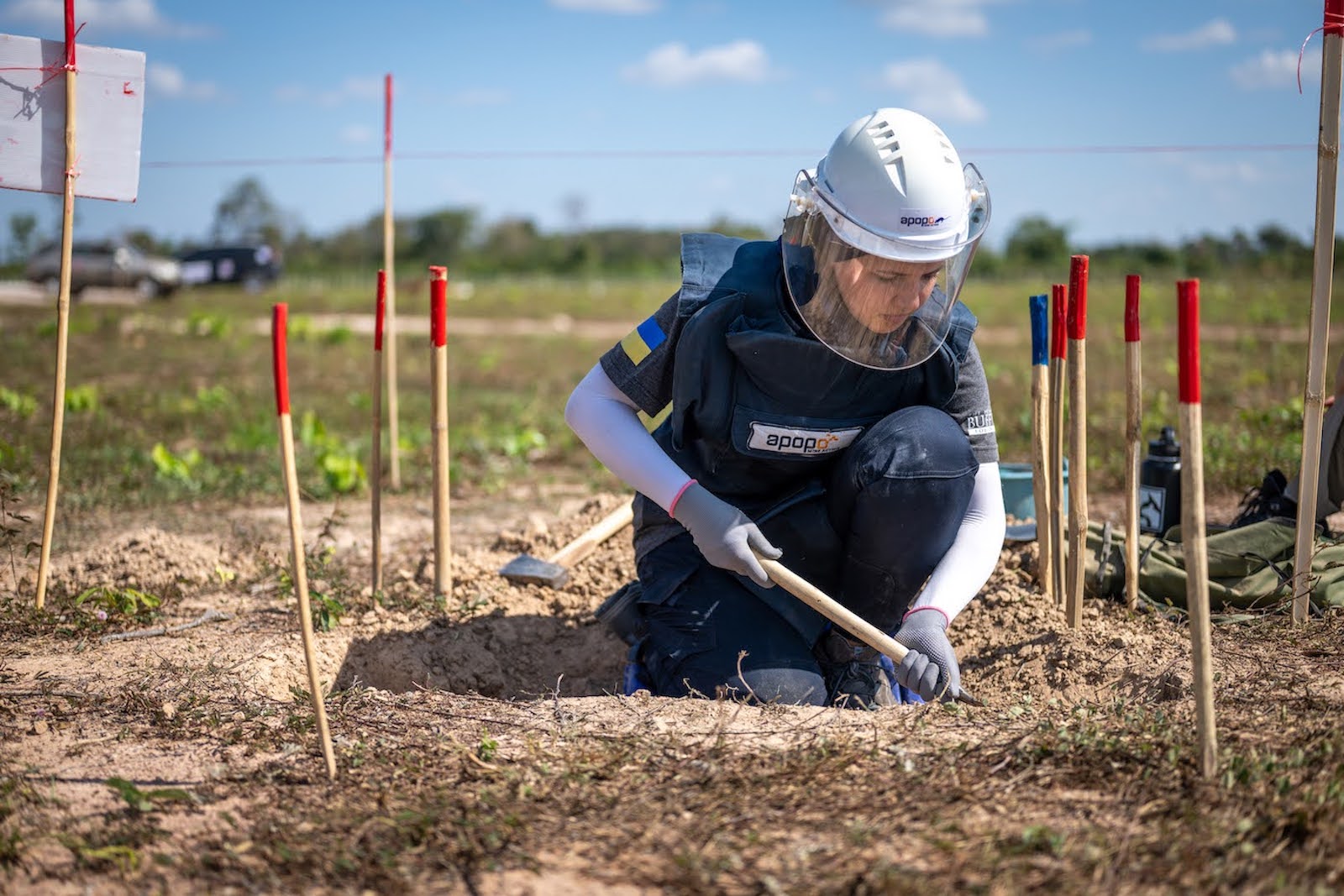
APOPO has co-signed a global statement led by the United Nations Mine Action Service (UNMAS) marking the International Day for Mine Awareness and Assistance in Mine Action on April 4, 2026, joining a group of international organizations calling for sustained investment in mine action as a foundation for peace and recovery.
For APOPO, that investment is not only about maintaining effort, but about improving how mine action is delivered in increasingly complex environments.
“Mine action is not only about removing threats. It is about how effectively we do it. Reaching people faster, working smarter in complex environments, and focusing efforts where they matter most can transform how quickly communities regain access to their land, their livelihoods, and their future,” said Christophe Cox, CEO of APOPO.
The UNMAS statement brings together operational agencies, UN bodies, and advocacy groups under this year’s theme, “Invest in Peace, Invest in Mine Action,” and reinforces the need to sustain both funding and political commitment across the sector.
Why this matters now
Landmines and other explosive remnants of war continue to affect how communities recover long after conflict ends. Their impact is immediate and practical. Land cannot be safely farmed, roads cannot be used, and reconstruction is delayed while contamination remains. Mine action removes these barriers. It allows people to return, rebuild, and move forward safely.
A collective call for investment in mine action
APOPO joins a group of UN agencies, international organizations, and networks in supporting the statement, including the United Nations Development Programme, the United Nations Office for Disarmament Affairs, the United Nations Office for Project Services, the Geneva International Centre for Humanitarian Disarmament, the Fondation Suisse de Déminage, Handicap International Switzerland, and the International Campaign to Ban Landmines – Cluster Munition Coalition.
Together, the signatories “call on governments, donors, and partners to reinforce support for mine action and to champion the international agreements that guide it. Investment in mine action is an investment in safer movement, renewed livelihoods, and resilient communities. It is an investment in peace itself.”
What that investment delivers
Mine action is not abstract. It is what allows land to be used again, infrastructure to function, and communities to resume daily life. Entire areas once considered unusable have been cleared and reopened. More than 30 countries have declared themselves mine free. Families have returned home, fields have been planted, and essential services restored.
These are the outcomes the statement points to, and the reason investment remains central.
The progress made so far is supported by international agreements such as the Anti-Personnel Mine Ban Convention and the Convention on Cluster Munitions, alongside more recent efforts like the Political Declaration on Explosive Weapons in Populated Areas.
As the joint statement points out, maintaining these commitments is part of the same effort. They reduce future harm while current contamination is addressed and help ensure that civilian protection remains central.
Continuing to invest in what works
Mine action delivers clear, practical results, but those results depend on sustained support. Continued investment determines how quickly land is cleared, how soon communities can return, and how recovery progresses.
On April 4, that call is being made clearly and collectively.
Quotes From Organizations
“Mine Action saves lives and supports vulnerable communities every day. It enables the delivery of vital humanitarian aid, facilitates the safe return home of displaced populations, ensures peacekeepers can work safely, sets the conditions for long-term peace and security, and assists with sustainable economic and social development. Investment in Mine Action is an investment in peace, and an investment in the future.” Kazumi Ogawa, UNMAS Director.
“Mine action restores more than land: it restores freedom, opportunity and the foundations for sustainable recovery in conflict-affected communities.” Shoko Noda, UNDP Crisis Bureau Director.
“Explosive ordnance continues to harm civilians long after conflicts fade from the headlines,” said Ambassador Tobias Privitelli, Director of the Geneva International Centre for Humanitarian Demining (GICHD). “Mine action is not only about removing weapons — it is about restoring safety, enabling recovery, and allowing communities to rebuild their futures with dignity.”
“Removing a landmine doesn’t just save a life. It allows a displaced family to sleep in their own beds again, a farmer to harvest his first wheat crop in years, schoolchildren to kick a ball on cleared playgrounds, a hospital to keep vaccines refrigerated through restored power lines, aid workers to reach people in need safely… That’s the true multiplier of mine action.” Hansjörg Eberle, Director of the Foundation suisse de déminage (FSD).
“Mine Action involves not only survey and clearance of contaminated land, but also advocacy to ensure there is no more use of mines or cluster munitions. We strongly encourage States Parties to the Mine Ban Convention and the Cluster Munition Coalition to promote the safety of civilians worldwide by publicly defending these conventions and their norms, condemning any new use, production, or transfer by any actor, under any circumstances.” Tamar Gabelnick, Director of the International Campaign to Ban Landmines (ICBL).
“The two treaties against mines and cluster bombs, and the political declaration against bombing and shelling in cities, are proof that determined mobilisation can change history. And they remind us today that, despite the legitimate security concerns of States, these prohibited weapons are neither a rational military response nor an acceptable option under humanitarian law.” Daniel Suda-Lang, Director of Handicap International Switzerland.
“If mine action is about creating safe ground for societies to rebuild, Switzerland’s role is to create safe ground for cooperation — connecting actors, fostering innovation and ensuring that Swiss expertise translates into global impact.” Catherine André, President of the Swiss Mine Action Network (SMAN).
“At a time when international norms such as the Ottawa Convention are under growing pressure, sustained commitment to mine action is more important than ever. The International Day for Mine Awareness reminds us that the work is far from finished — especially in places that have faded from global attention, but where explosive hazards continue to shape daily life. This is where we work, alongside affected communities, to restore safety and create the conditions for lasting peace.” Rolf Stocker, Co-President of the Foundation Board of World Without Mines Foundation.
“Mine action is the first step toward reconstruction. By combining advanced technology with operational expertise, we not only clear land, but enable infrastructure to be rebuilt, economies to recover, and communities to move forward safely and sustainably. This requires close collaboration between governments, industry, NGOs and international partners to deliver impact at the scale that is needed” Philipp von Michaelis, CEO of Global Clearance Solutions.
“After the war, it is civilians who suffer the consequences for decades. Landmines have impacts that go far beyond physical harm—they also hinder the economic and social development of affected regions. The costs of demining and providing assistance to victims are extremely high and vastly disproportionate to the initial purchase price of the mines.” Reto Stump, President of the Mine-ex foundation.