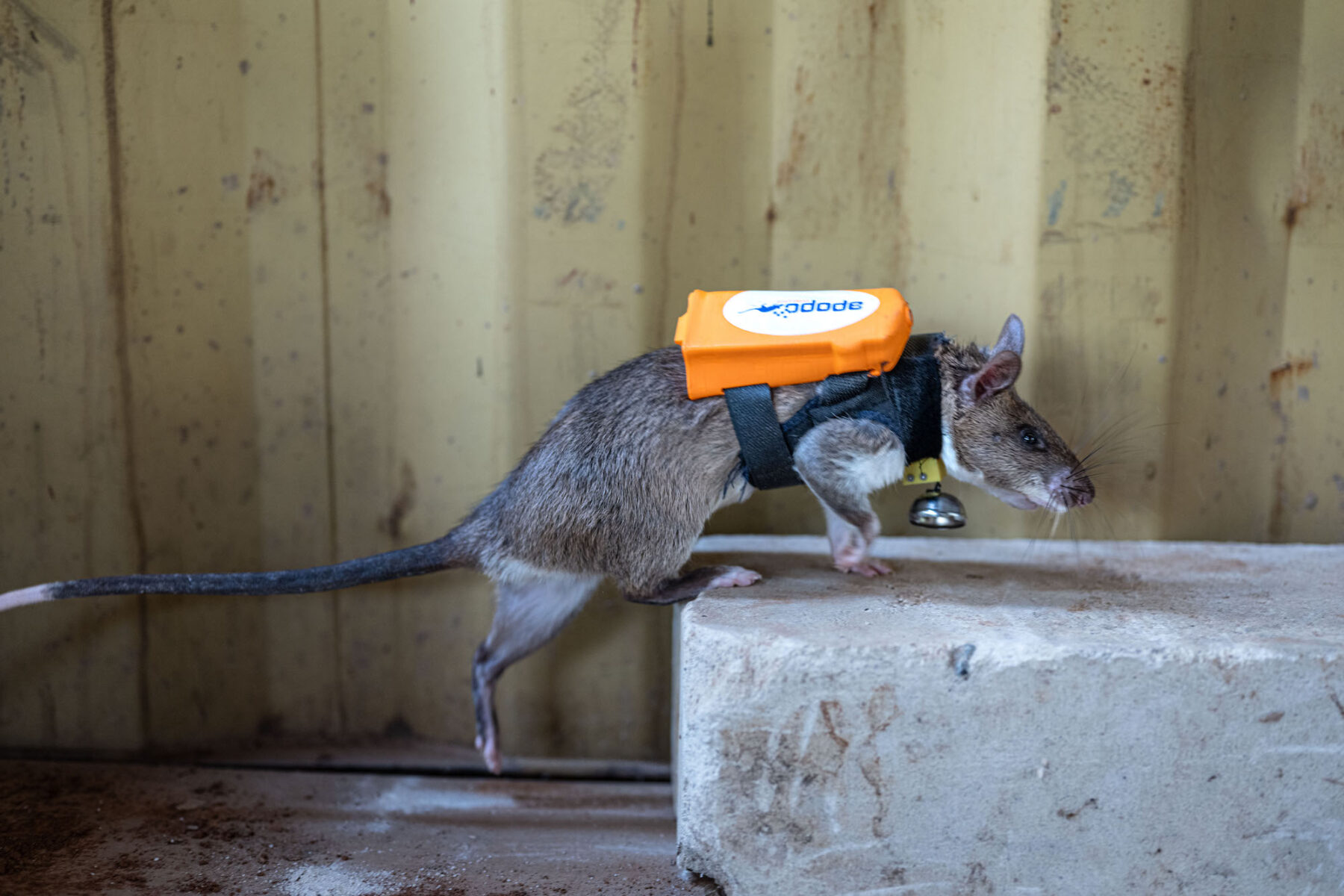
How much does it weigh? What happens if it gets caught? And what on earth are Wi-Fi HaLow, RTK GPS, and SLAM? Electrical engineer Sander Verdiesen, APOPO’s Technical Lead – R&D within the Innovation Department, explains how three tiny backpacks are being developed to solve three very different problems.
Put a backpack on a rat and people will, quite reasonably, have questions. What is inside it? Is there really a camera? Can the rat carry it comfortably? What happens if it gets stuck? And why does a wildlife detection rat need a brighter light and a louder beep?
The answers reveal how much engineering can fit into a device weighing less than 100 grams. They also reveal the extraordinary care needed to ensure that every component helps the rat do its job without getting in its way.
Why does a rat need a backpack?
The backpack does not improve the HeroRAT’s sense of smell or find the target on its behalf. The rat already brings the nose, agility, and trainability. The backpack solves the communication gap between what the rat can do and what APOPO’s human teams need to know.
An African giant pouched rat (Cricetomys ansorgei) can enter rubble that rescuers cannot safely access, move through grass tall enough to hide it from its handler, or search in a dark and noisy environment. It can locate a target, but the people working with it may also need to know its position, receive an unmistakable indication, record the area it has covered, or see what is happening around it. In a collapsed building, they may even need to speak to the person it has found.
In other words, the rat does the searching. The backpack makes what the rat discovers visible, locatable, recordable, and useful to the wider team. As Sander puts it, “By giving them a backpack, we can see and hear what the rat sees and hears. We are combining millions of years of evolution with modern technology.”
From a sketch to a working prototype

The story began when Sander was studying at Eindhoven University of Technology (TU/e) and looking for an internship with a nonprofit organization. He contacted several, including APOPO, and received a reply from CEO Christophe Cox.
Christophe sent him some initial sketches of a rat wearing a backpack while performing search and rescue work. APOPO had considered the idea several years earlier but had put it aside. Could Sander develop the first prototype? The aim was to train rats to navigate the rubble of collapsed buildings and find survivors. Finding someone, however, would not be enough if rescue workers could not see where the rat had gone, understand the space around it, or communicate with the person it had located. The backpack would provide that missing connection.
Sander began work, and three months later, he flew to Tanzania to test the result. The prototype performed better than expected, giving the project new momentum. That first RescueRAT backpack also began a much longer development process. It has since been joined by separate backpacks for technical survey and wildlife detection. Lessons can pass from one design to another, but this is not one universal gadget gradually being perfected. The three backpacks have different jobs because they solve different problems.
Three backpacks, three problems
RescueRATs: Finding a survivor is not enough
While larger than most other species of rat, APOPO’s African giant pouched rats are still small and agile enough to enter gaps within collapsed structures that humans cannot. This gives them the potential to search for survivors while rescue workers remain outside. The difficulty is communicating what they find.
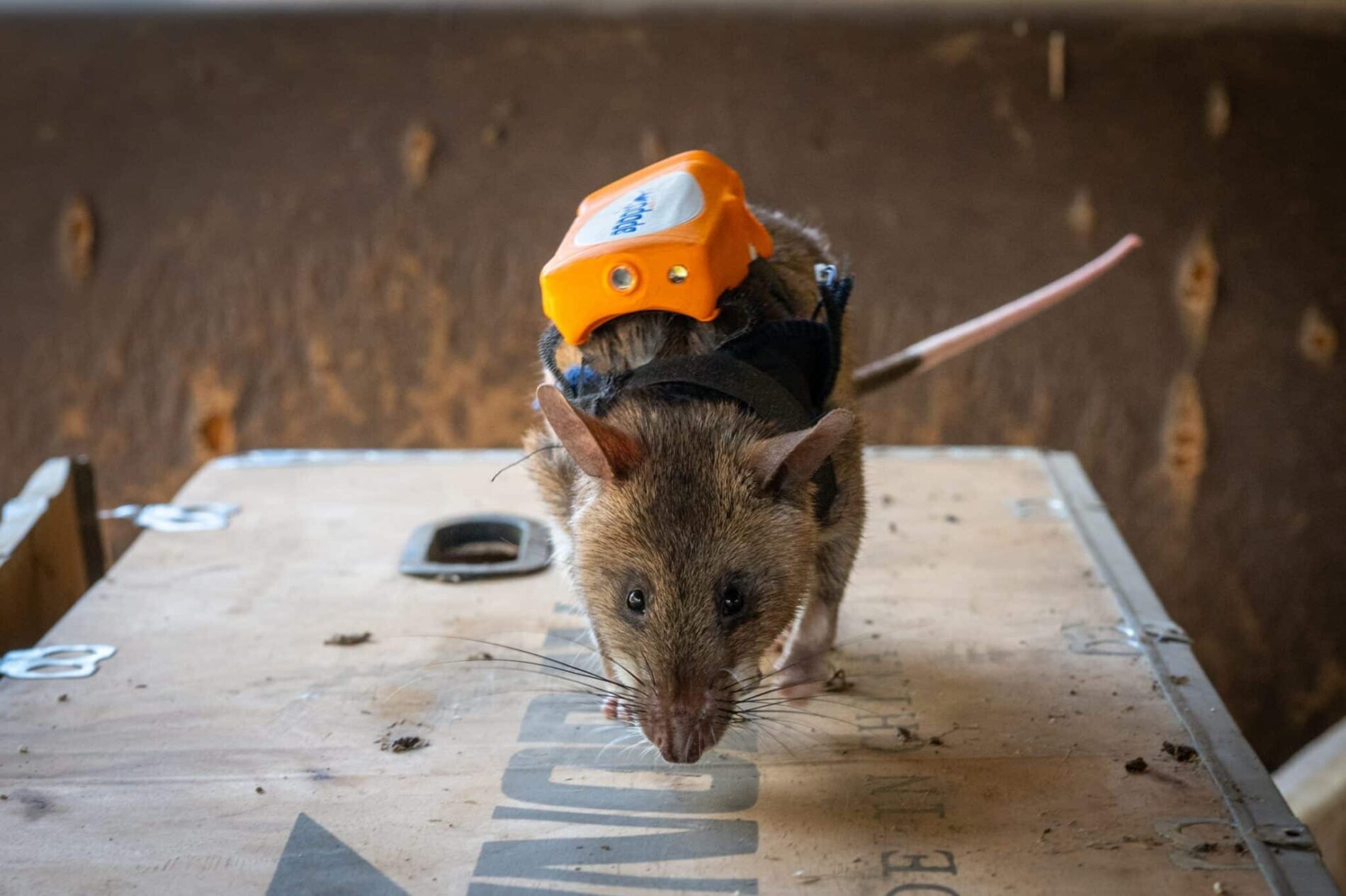
The RescueRAT backpack gives rescue teams eyes and ears inside the rubble. Its camera and microphone allow them to see and hear what is around the rat, while two-way audio enables them to speak with a potential survivor. Images from inside could also help the team understand the damaged structure and identify a safer way to reach and extract the person.
Technical Survey: When the rat disappears from view
During technical survey work, a rat may move through tall grass, where its handler cannot see exactly where it is or which route it has taken.
This creates two practical problems. Teams need to demonstrate that the rat has covered a particular area before the land can be released. If the rat indicates a possible explosive item, deminers must also be able to find the precise location.
The technical survey backpack records the rat’s route and can drop a small beacon at the site of an indication.
Wildlife Detection: Making sure an indication is noticed
Wildlife Detection Rats may work in environments that are dark, noisy, or both. Even when a rat makes the trained indication that it has detected a target odor, its handler may not be able to see or hear it clearly.
When the rat presses its indicator switch, the wildlife backpack activates a bright LED and a beeper. It also sends a radio signal to a receiver carried by the handler, which lights up, beeps, and vibrates.
Working within a 100-gram limit
The obvious difficulty in building technology for a rat is that almost everything has to become very small, very quickly. “As a rule of thumb, any animal should not carry more than 10% of its body weight for a prolonged period,” Sander explains. “Our lightest rats weigh around one kilogram, so that gives us a maximum weight of 100 grams.”
The newest RescueRAT backpack weighs 75 grams. The technical survey backpack is currently around 90 grams, while the wildlife backpack weighs approximately 60 grams.
Achieving those figures while fitting in the necessary electronics is an ongoing challenge. Sander must consider not only what each component does, but how much it weighs, how much space and power it requires, whether it affects the balance of the pack, and whether it creates a point that could catch on something.
Designing for a rat’s body

A backpack can meet its weight target and still be completely wrong for a rat. The backpack must follow the shape of the rat’s back, sit securely, have no sharp edges, and allow the animal to move naturally.
“I try to make sure that all the edges on the backpack are smooth and aerodynamic,” Sander says. “This reduces the chance of anything catching on the backpack, which is especially important for the RescueRats.”
The earliest RescueRAT backpack had a camera lens protruding from its casing. “While this looks cool and is clearly a camera, it is likely to get stuck,” Sander says. The latest version places a smaller camera inside the backpack, leaving nothing protruding that could snag.
The position of the components matters just as much as the exterior shape. In one version, the battery sat near the top. This created a high center of gravity, making the backpack unstable and causing it to slide to one side. Current designs keep their weight lower. If a backpack does become caught despite these precautions, Sander explains the rats have a natural ability to maneuver out of and through tight spaces and have actually demonstrated this in test situations by squeezing out of the backpack when necessary.

Rat welfare is part of the engineering brief
A HeroRAT is not simply a platform for carrying electronics. Its safety, comfort, behavior, and freedom of movement all form a major part of the design brief. That affects how the backpack is introduced as well as how it is built. When the rats are still young, they begin training with a backpack containing small stones. The weight is increased gradually until they can comfortably carry a functioning unit. “Trainers look for various signs in their behavior, such as not wanting to walk or trying to take off the backpack,” Sander says.
Sander defers to APOPO’s trainers on the finer details of this process and asks for input from the rat experts throughout development. Their observations help establish whether a design works for the animal wearing it, not merely whether the electronics function on a workbench.
The battery receives particular attention because Sander considers it the greatest safety risk inside the backpack. He incorporates three levels of protection, using separate electronic circuits to prevent overloading and detect when something is wrong.
“We have done everything to ensure the rat’s comfort and especially its safety,” Sander says. “We would not give our rats a backpack to carry if we did not believe that. If they felt uncomfortable wearing it, they have numerous ways of telling us.”
What is inside the RescueRAT backpack?
The latest RescueRAT backpack contains a communications module, microprocessor, camera, speaker, microphone, flashlight, cooling fan, battery, and battery-management system. All of this fits inside a lightweight, 3D-printed enclosure.
Together, these components allow the backpack to transmit video and two-way audio, record sound and images locally, illuminate dark spaces, and connect to the switch the rat uses to indicate that it has found someone. It currently provides approximately 35 minutes of battery life while streaming video.
The RescueRAT system also includes a custom Android app. Rescue teams can use it to control the video, incoming and outgoing audio, flashlight, cooling fan, and a setting that increases the brightness of the image in dark spaces. The app displays the live feed and allows the team to monitor processor temperature, available storage, and battery life.
The backpack may be tiny, but it still has to function as part of a practical system for the people using it.
Getting a signal through rubble
Collecting video and audio is only useful if the backpack can send that information to the rescue team outside.
The latest version uses Wi-Fi HaLow. Standard Wi-Fi commonly operates at around 2,400 MHz, while Wi-Fi HaLow uses a much lower frequency of approximately 900 MHz. This allows the signal to penetrate farther into rubble. It does not remove the problem entirely. Thick, irregular layers of debris can still interrupt the connection, which is why APOPO is also exploring mesh networking.
Sander explains a conventional network by comparing it to a bicycle wheel. The devices are the spokes, all communicating with one central hub. If a device cannot reach that hub, the connection is lost.
A mesh network is more like a fishing net. Devices can communicate with one another and relay messages when two points cannot connect directly. “Even if one of the connections is broken, the network still holds together, and all devices can be reached,” Sander explains. “For the RescueRATs, this is especially important because radio signals do not travel well through rubble.”
Wi-Fi HaLow describes how the current backpack transmits its data. Mesh networking could give that data an alternative route when a direct connection is blocked. Fitting both into a lightweight system and making them work reliably inside collapsed structures remains a considerable engineering challenge.

Locating a RescueRAT without GPS
Communication tells the rescue team what the rat is seeing. The next challenge is establishing where it is seeing it. GPS does not work beneath rubble, so the current RescueRAT backpack does not include a GPS module. Sander is investigating alternatives, including triangulation and visual odometry using the camera and an accelerometer.
APOPO is also exploring simultaneous localization and mapping, better known as SLAM. Sander explains it by asking us to imagine the camera tracking a recognizable point, such as the edge of a table. “By checking how much each point has moved in the next frame, the algorithm can estimate the distance that the camera has traveled. In doing so, it can determine the location and make a 3D map of the environment. For rescue workers, that map could help answer two vital questions: Where is the survivor, and what does the damaged structure between us and them look like?”
Sander is careful not to present this as a finished capability. “In theory, mesh networking and SLAM should both work, but putting that into practice is a lot harder and is not guaranteed.”
Why technical survey needs more accurate GPS
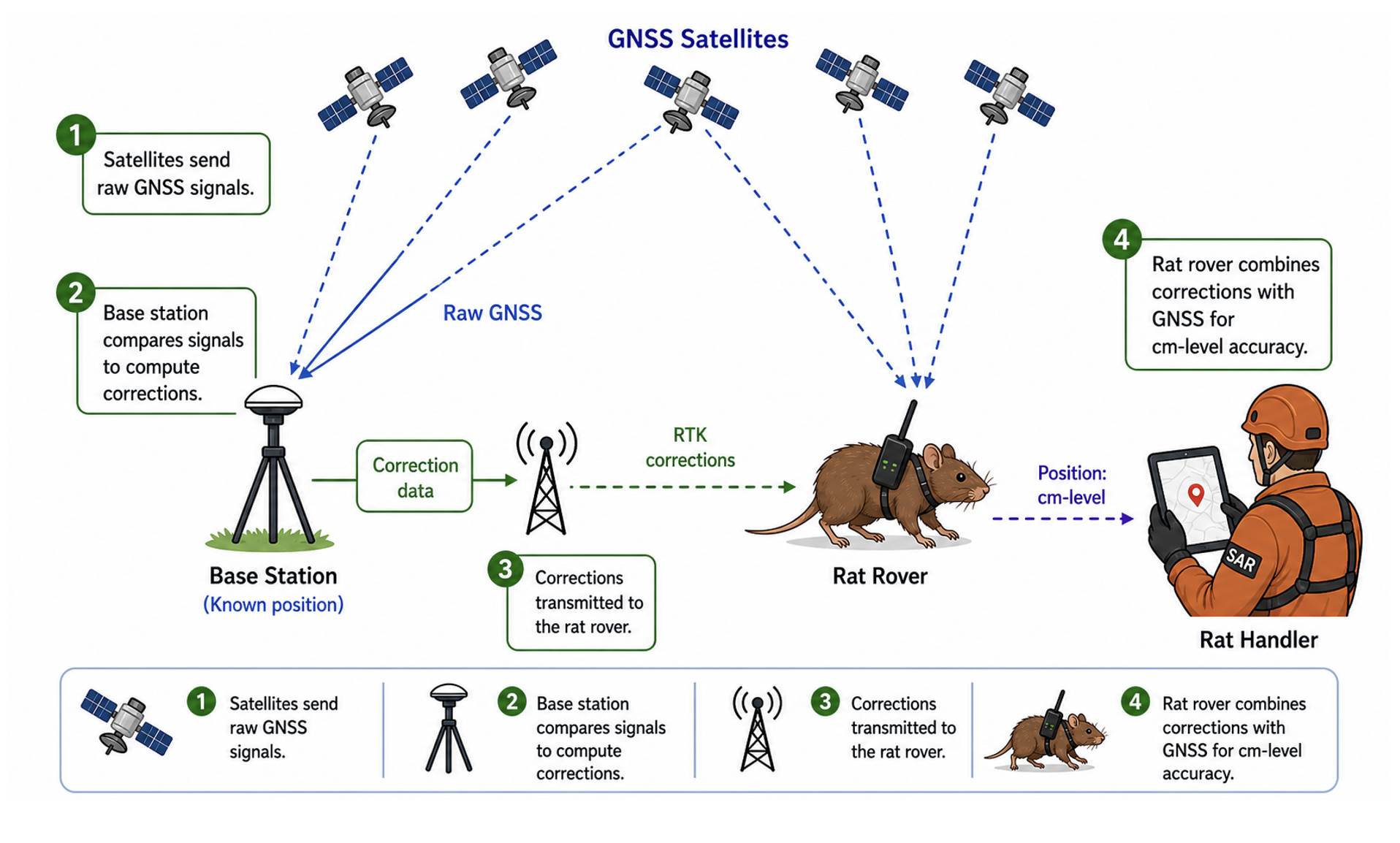
The technical survey backpack has a different location problem. It operates above ground and can use GPS, but conventional GPS may only be accurate to within a few meters.
During training, targets are buried at known points. If the rat is hidden by tall grass, the trainer needs sufficiently accurate location data to determine whether it has indicated at the correct spot and should receive a reward. “We cannot say for certain that the rat is in the right location,” Sander says of conventional GPS. “Therefore, we do not know if we should reward the rat.”
The proposed solution is RTK GPS, or real-time kinematic positioning, which can provide much greater precision. Sander also makes clear that the need for this degree of accuracy is currently best established in training. Whether operations will require the same precision is still being discussed.
What’s next for the backpacks?

The development story of these backpacks is not a straight line from a rough first attempt to a perfect final backpack. Since Sander built the first RescueRAT prototype in 2019, successive versions have become smaller, lighter, and more capable. The white backpack familiar from much of the early media coverage was the first prototype. The newest version is orange and, Sander says, improved across the board.
Even the choice of processor reflects the project’s experimental stage. The current backpack uses a microprocessor because it makes trying new ideas easier. Once experimentation is complete, Sander expects to switch to a more power-efficient microcontroller.
Some of the planned improvements are strikingly practical. The backpack needs greater resistance to water ingress, and an upgraded speaker currently outside the main housing must be moved inside. The vest works, but takes time and skill to put on, so a simpler design is needed. Sander is also considering prerecorded messages that could be played to a casualty through the backpack.
Other possibilities are more ambitious. Sander would like to explore whether the camera or another sensor could help determine whether a person beneath the rubble is still alive. This remains a future research goal, not a capability of the current backpack.
He has also been asked to add a camera to a future wildlife backpack for rats searching inside shipping containers, although that work has not yet begun.
The three backpack systems are at different stages. The wildlife backpack is already being used operationally, although field experience may reveal further improvements in robustness and reliability. The technical survey backpack remains an early version, with opportunities to reduce its size and weight. Sander believes the latest RescueRAT backpack satisfies its core design requirements, but localization, mapping, network resilience, and operational durability still require further development and testing.
Every gram has to earn its place
That painstaking process is the real story inside the backpacks. The technology may be ingenious, but it only succeeds if it solves the right operational problem and works with the rat rather than getting in its way.
Millions of years of evolution have already produced an agile animal with an extraordinary sense of smell. APOPO’s challenge is to add the right technology for the right task, and to make sure every gram, edge, signal, and circuit earns its place.
