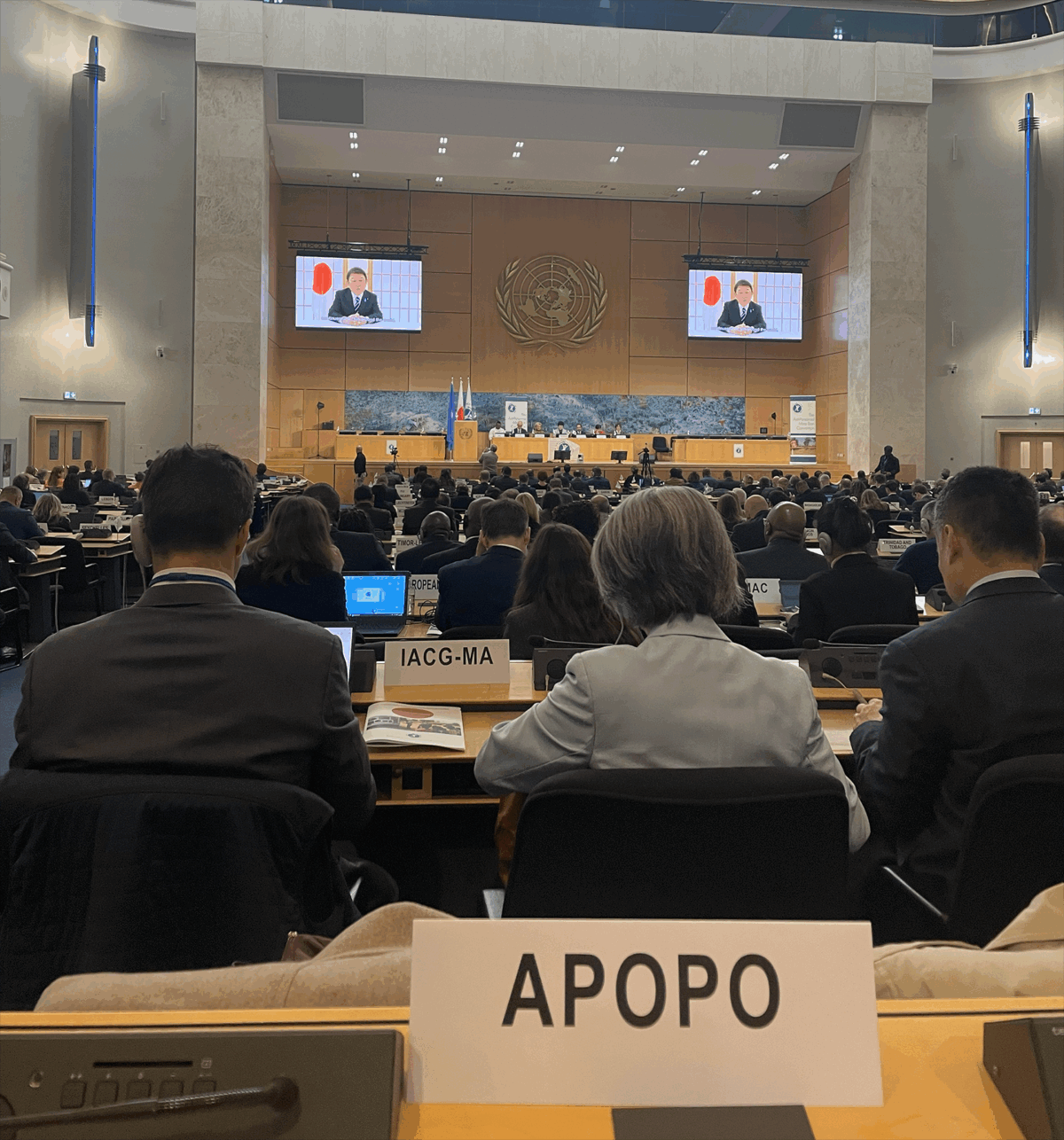
Geneva, December 5, 2025 — APOPO participated in the 22nd Meeting of States Parties (MSP22) to the Anti-Personnel Mine Ban Convention, held in Geneva from December 1–5, 2025, where we were formally accredited as an observer. The meeting brought together States Parties, mine action operators, disarmament and humanitarian organizations, and international partners to review progress on treaty implementation and strengthen collective action against anti-personnel mines.
As a long-standing humanitarian demining operator and global innovator in Animal Detection Systems (ADS), APOPO followed plenary discussions, shared operational perspectives, and engaged with delegations and partners to support effective, safe, and evidence-based mine action.
Recognition of APOPO’s Operational Role
APOPO was referenced during plenary discussions across several thematic areas, reflecting our contributions to operational innovation, national capacity building, and financing approaches within the mine action sector.
The Geneva International Centre for Humanitarian Demining (GICHD) highlighted the importance of innovation in clearance operations, explicitly referencing APOPO’s use of rats and dogs as detection tools that increase efficiency while maintaining safety standards. Japan acknowledged APOPO’s role in strengthening national ADS capacity, recognizing the value of transferring technical expertise and operational responsibility to national authorities and institutions.
The United Kingdom’s Foreign, Commonwealth & Development Office (FCDO) referenced APOPO in relation to the Development Impact Bond (DIB) supporting the Minefields to Rice Fields program in Cambodia. A DIB is an outcomes-based financing mechanism in which upfront funding from private or philanthropic investors enables program delivery, while outcome funders repay investors only if independently verified results are achieved. In this case, the Minefields to Rice Fields program supports the clearance of land contaminated by landmines and unexploded ordnance and its safe return to productive agricultural use, allowing farming communities to restore livelihoods and food security. APOPO contributes to this program through large-scale, efficient land clearance using its Animal Detection Systems.
Zimbabwe also referenced APOPO during discussions, noting our departure from the country in 2025 due to funding constraints. These constraints were linked to reductions in United States foreign assistance earlier in the year, illustrating how shifts in donor funding can directly affect operational continuity and national clearance progress.
Bilateral and Multilateral Engagement at MSP22
Alongside plenary participation, APOPO held meetings with a wide range of partners and stakeholders, including Mines Advisory Group (MAG), Norwegian People’s Aid (NPA), Humanity & Inclusion (HI), the International Trust Fund for Demining and Mine Victims Assistance (ITF), the Japan International Cooperation Agency (JICA), the International Campaign to Ban Landmines (ICBL), the Organization of American States (OAS), the Cambodian Mine Action and Victim Assistance Authority (CMAA), Mine Action Review, national authorities and donor representatives, as well as the UN’s Implementation Support Unit (ISU) and GICHD.
These engagements strengthened coordination, reinforced existing partnerships, and supported dialogue on operational priorities, national ownership, and sustainable financing for mine action.
Treaty Implementation and Policy Context
APOPO supported the ICBL joint civil society statement, reaffirming the role of civil society organizations in promoting full implementation of the Anti-Personnel Mine Ban Convention and sustained political commitment to its objectives.
A key treaty development at MSP22 was the approval of Article 5 extension requests for Cambodia and Ethiopia. Article 5 of the Anti-Personnel Mine Ban Convention obliges States Parties to clear all anti-personnel mines from areas under their jurisdiction or control within a specified deadline, originally set at ten years from the Convention’s entry into force for each State. When countries are unable to meet this obligation due to factors such as the scale of contamination, technical challenges, or funding limitations, they may request an extension. Approval of these extensions allows clearance operations to continue within an agreed and monitored timeframe, ensuring transparency and accountability while recognizing operational realities on the ground.
High-Level Engagements

APOPO held a one-to-one meeting with Her Royal Highness Princess Astrid of Belgium, during which we provided an update on operational developments since her visit to APOPO in 2011. The exchange reinforced Belgium’s long-standing interest in humanitarian mine action and APOPO’s work.
We also participated in a high-level civil society roundtable with His Royal Highness Prince Mired of Jordan, alongside organizations including the ICBL, Norwegian People’s Aid, Mines Advisory Group, The HALO Trust, Humanity & Inclusion, and the Cambodia Campaign to Ban Landmines and Cluster Munitions (CCCM). Discussions focused on sector-wide challenges, operational lessons, and the continued importance of collaboration between civil society, operators, and States Parties.
Belgium’s Treaty Presidency and APOPO’s Role

Belgium was elected President of the Anti-Personnel Mine Ban Convention for 2027. This is particularly significant for APOPO as the only Belgian humanitarian mine action organization, and it opens opportunities for continued engagement and contribution to treaty processes in the lead-up to Belgium’s presidency.
APOPO’s participation in MSP22 demonstrated our ongoing commitment to the objectives of the Anti-Personnel Mine Ban Convention, our contribution to evidence-based policy dialogue, and our dedication to advancing innovative and effective approaches to humanitarian demining in pursuit of a world free of anti-personnel mines.