
24 November 2025, Denmark – The 2025 Union World Conference on Lung Health took place in Copenhagen from 18 to 21 November, bringing together researchers, clinicians, National TB Program managers, policymakers and operational partners from around the world. APOPO participated with a delegation led by Dr. Tefera B. Agizew, Head of APOPO’s TB Department, and Dr. Negussie Beyene, Country Representative in Ethiopia. Their involvement reflected APOPO’s commitment to improving TB detection in low-resource settings and contributing to global scientific discussion. This year’s conference also centered on three major scientific themes: the impact of USAID funding withdrawal on global TB programs; the increasing focus on alternative non-sputum samples for diagnosis; and the growing evidence supporting sputum sample pooling for screening in high-risk populations.
The Union Conference remains the most influential annual meeting in the TB field. It is where scientific findings, operational lessons and policy decisions come together. Countries use the meeting to assess progress, researchers introduce tools that may shape future TB control strategies, and implementers discuss how these tools might work in real-world health systems.
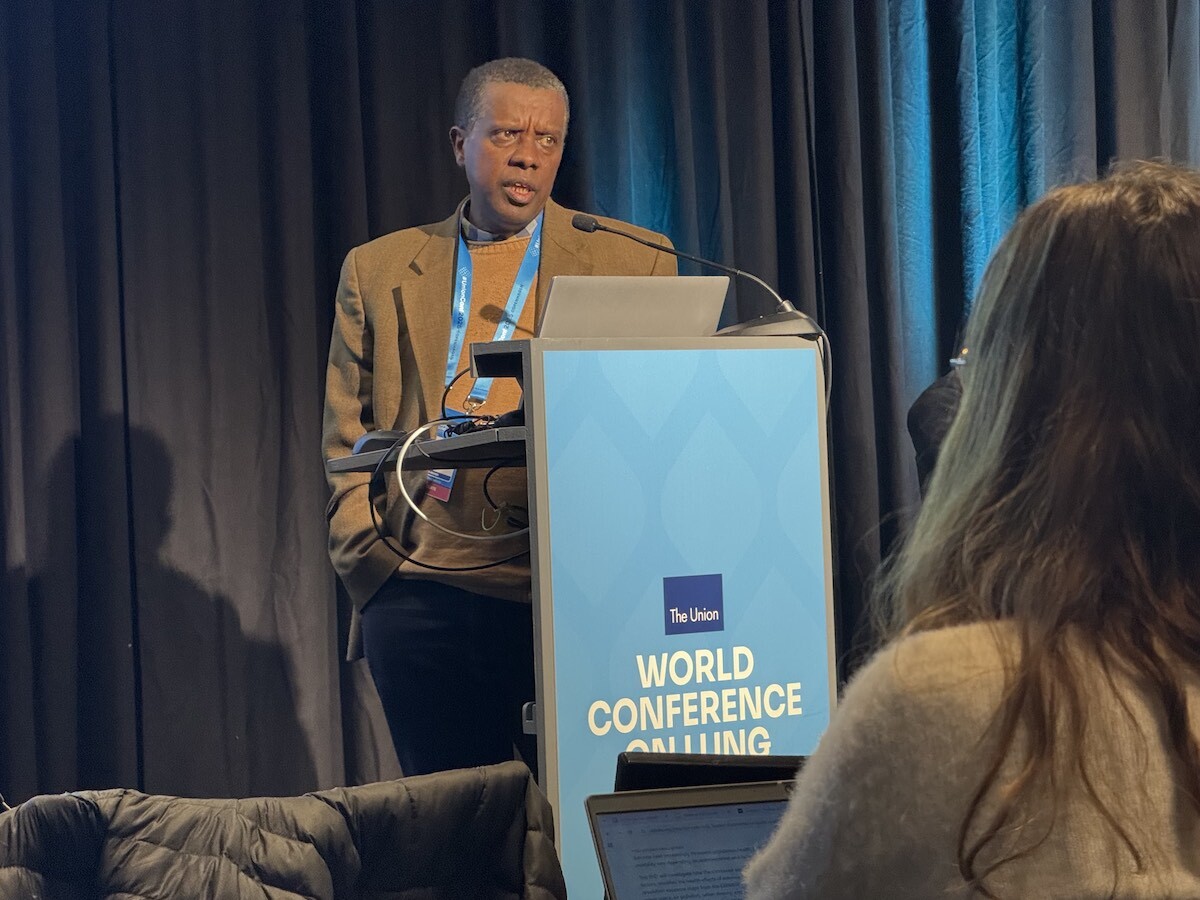
As part of the scientific program, APOPO also presented on the role of TB detection rats in identifying cases with very low bacterial loads, particularly in settings where routine diagnostics or new molecular tests may miss early or paucibacillary disease. Dr. Tefera Agizew and Dr. Negussie Beyene shared operational evidence from APOPO’s TB detection work, emphasizing how rat-based second-line screening can strengthen case finding alongside emerging non-sputum and molecular diagnostic approaches. Their contribution underscored the continued relevance of affordable, scalable complementary tools within national TB diagnostic algorithms.
In addition, several papers presented at the conference examined the consequences of USAID’s withdrawal of TB program support. Modeling studies showed that without replacement funding, national, regional and global TB control efforts could experience setbacks, with longer timelines projected for reducing TB incidence and mortality. Although promising new TB vaccine candidates were highlighted, speakers emphasized that large-scale trials, manufacturing, distribution to high-burden countries and impact assessments are likely at least a decade away.
Understanding the Global TB Burden
Despite being preventable and curable, TB is still one of the world’s leading infectious killers. According to the World Health Organization, 10.7 million people fell ill with TB last year, yet only 8.3 million were diagnosed and reported. That leaves 2.4 million people with undetected disease who do not begin treatment and continue transmitting TB to others. TB caused 1.23 million deaths globally. Although this represents some recovery from the COVID-19 period, the world remains off track from End TB milestones.
Progress in Diagnostics and the Limits of New Tools
A significant number of diagnostic presentations focused on the use of tongue, mouth and oral swabs for molecular TB testing. The volume of evidence shared suggests that WHO approval for oral-swab–based molecular diagnostics may be forthcoming. This trend aligns with APOPO’s longstanding advocacy for evaluating alternative samples such as saliva, urine, sebum and sweat for rat-based TB detection, reinforcing the importance of continued research in this area.
Sample pooling also received considerable attention at the conference. Many studies highlighted its public health impact and cost-effectiveness in high-risk settings such as prisons. A scientific advisory group submitted a full evidence dossier to WHO the week before the conference, recommending endorsement. APOPO Ethiopia’s long-running prison screening program was referenced as a practical example: more than 46,000 prison community members reached since 2019, 39,410 people screened and 143 microbiologically confirmed cases identified, 64% of which reported no symptoms. These findings support the ongoing integration of pooling into large-scale screening campaigns in Addis Ababa’s maximum-security prisons.
A central scientific topic at the Union World Conference this year was MiniDock MTB, a near point-of-care molecular test that uses a tongue swab instead of sputum. Sputum can be very difficult for patients to produce, especially children, elderly individuals and people with mild or early disease. A reliable non-sputum test, which uses a sample that is much easier to collect, could therefore expand access to diagnosis, particularly in primary-care facilities. Early evaluations suggest the test meets the WHO Target Product Profile for non-sputum TB diagnostics.
However, the sensitivity of MiniDock MTB remains limited, though better than sputum-smear microscopy, especially when bacterial levels are low. These are often the cases already most likely to be missed by frontline diagnostics.
Dr. Tefera noted, “Even with new diagnostics coming to market, reduced sensitivity means many people with TB are still missed. This is where APOPO’s detection model adds value, especially for samples with low bacterial loads.”
What APOPO’s Detection Model Is and Why It Works in Low-Resource Settings
APOPO’s TB detection model uses trained African giant pouched rats (Cricetomys ansorgei) to screen sputum samples quickly and cost-effectively. The rats, also known as HeroRATs, act as a high-throughput second screen by sniffing the sputum samples and indicating on any in which they detect the volatile organic compound odor of the tuberculosis bacterium. After clinics use their routine diagnostic method, APOPO retests the same samples with the rats. Any sample indicated by a rat is then confirmed with molecular or concentrated smear microscopy testing.
This approach helps in several ways. A single rat can evaluate hundreds of samples in minutes, far more than a technician can process in the same timeframe. Rats are also able to detect TB in samples with very low bacterial loads, which are often missed by smear microscopy or molecular tests. This makes the model particularly useful for identifying people with early-stage illness, HIV co-infection or minimal symptoms.
Because the system is low-cost, requires limited infrastructure and integrates smoothly into national workflows, it is well suited to low-resource health systems. It expands the number of people who can be diagnosed without replacing existing tools and provides an affordable complement to molecular testing. In countries with high TB burden and limited laboratory capacity, this can translate into a 48% increase in case detection compared with clinic diagnostics alone, according to APOPO’s 2025 study on second-line TB screening published in PLOS ONE Agizew et al (2025).
What Modeling Tells Us About the Future of TB Control
Another major message from the conference was the slow pace of global progress. New modeling presented in Copenhagen estimated that, if current rates of diagnosis and treatment continue, it may take 85 to 135 years to achieve an 80% reduction in TB incidence by 2034 compared with 2015. These projections reflect delays in diagnosis, limited access to high-quality testing, the burden of malnutrition and other underlying conditions, and the broader socioeconomic context in which TB thrives.
The modeling was a call for practical and scalable solutions that can be deployed immediately. As Dr. Tefera said, “The data is a clear reminder that we need complementary solutions. Rapid tests alone will not close the detection gap.”
The Impact of Asymptomatic and Minimally Symptomatic TB
Several presentations focused on the challenge of asymptomatic TB. In some settings, particularly in southern African studies, more than 50% of people identified with TB during screening reported no symptoms at the time. Individuals who feel well rarely seek care, yet they can still transmit TB. This silent burden complicates elimination efforts and highlights the need for screening approaches that can manage large sample volumes at low cost. APOPO’s high-throughput model is well suited to these demands, particularly where laboratories are overstretched.
TB in Ethiopia and Tanzania: Why Scalable Approaches Matter
Ethiopia and Tanzania, two countries where APOPO operates or collaborates closely with national programs, remain among the 30 high-burden TB countries. Ethiopia records an estimated 186,000 cases each year (141 per 100,000 population), and Tanzania around 118,000 cases (172 per 100,000). These numbers capture diagnosed cases only. Given the global pattern of missed cases, the true incidence is likely higher. In the Tanzania case more than 35% of TB cases were estimated to be missed in 2024. While both countries have expanded diagnostic capacity, they still rely on tools that may miss a proportion of cases with low bacterial loads.
Collaboration, Innovation and the Path Forward
The conference also served as an important venue for partnership-building. APOPO’s team met with researchers from Uganda interested in exploring collaboration. Discussions covered operational feasibility, integration into existing national systems and potential for future research. Dr. Tefera emphasized the importance of these connections, saying, “Partnerships are essential if we are to scale effective detection strategies.”
There was also renewed interest in sputum pooling, a cost-saving approach used in Ethiopia since 2019 that has now been submitted for WHO endorsement. Wider adoption of pooling could help countries test more people with the same resources.
Throughout the conference, APOPO participated in conversations with Union board members and the scientific committee. The discussions highlighted the need for innovation that translates into real-world impact, especially in countries with limited laboratory capacity. APOPO’s operational experience and high-throughput model position it well to contribute to these efforts.
APOPO’s Continued Commitment to a More Effective Global TB Response
The 2025 Union Conference closed with a clear message: global progress on TB must accelerate and existing diagnostics, while improving, are not yet enough to meet the needs of high-burden countries. Practical, scalable detection methods remain essential to closing the gap. As countries work to recover lost ground and identify the millions of TB-infected people currently missing each year, APOPO will continue supporting partners with tools that improve early detection, speed up treatment initiation and help reduce transmission.